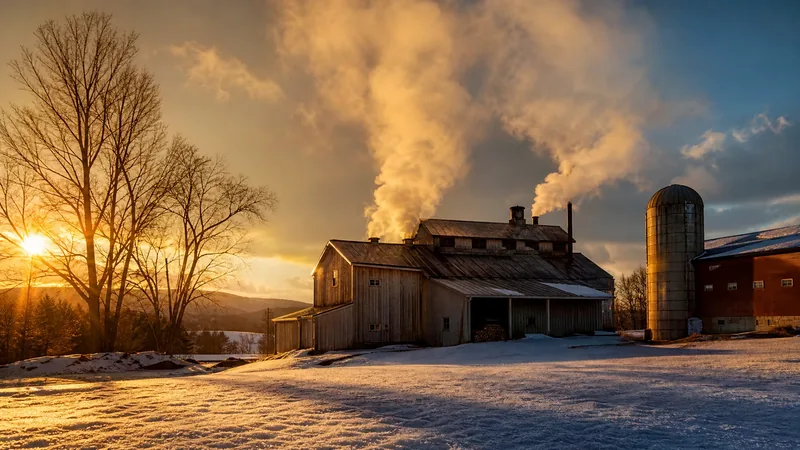
How to Start a Maple Syrup Business in Vermont: No Producer License, Grade A Classes, 66.9 Brix Density and Dealer or Processor Licenses ($30, $150)
How to Start a Maple Syrup Business in Vermont: No Producer License, Grade A Classes, 66.9 Brix Density and Dealer or Processor Licenses ($30, $150)
If you make maple syrup in Vermont and plan to sell it, the good news is that a producer who packs its own syrup does not need a state license. The rules that matter are the ones that govern how the syrup is graded, how dense it is, how the jar is labeled, and how the business is taxed. Those rules are what most new producers get wrong. This guide walks through how to start a maple syrup business in Vermont, in the order you will likely need to handle each piece.
Informational content only: This article is general information, not legal or tax advice. Rules, fees and thresholds change. Confirm current requirements with the agencies named below, and talk to a qualified attorney or CPA before you make decisions about entity structure, taxes or a large operation.
What You Actually Need to Get Started
Vermont has no general statewide business license. Instead, a maple business typically needs four things: a registered business entity (or a decision to operate as a sole proprietor), a Department of Taxes account if you collect tax or withholding, the specific licenses for your activity, and compliance with the Vermont maple syrup grading rules. The Secretary of State's Business Services Division handles entity filings, and the Agency of Agriculture, Food and Markets handles the maple rules.
Here is the core distinction that affects your startup cost:
- Producer: You collect sap and make syrup, and you pack your own syrup. No state producer license is required.
- Dealer: You buy or acquire 1,000 gallons or more of syrup a year for packaging for resale or for bulk resale. The license costs $30.
- Processor: You buy or acquire 2,500 gallons or more a year, including processing syrup into other products. The license costs $150.
Materials and Equipment Checklist
Before you commit to a setup, gather the following. The list covers the production and compliance tools most small operations need. Costs for production equipment vary widely, so get quotes rather than relying on estimates.
- Sap collection system: taps, lines or buckets, and a vacuum system if you use one.
- Evaporator and pan: the equipment that turns sap into syrup.
- Hydrometer or refractometer: you need a way to measure density in degrees Brix or Baume. A Baume hydrometer is the traditional tool, and a refractometer is common for finished syrup.
- Thermometer: you need to check temperature, because the density reading depends on it. The Vermont standard uses 60 F.
- Filters and filter media: for clarifying finished syrup before bottling.
- Bottles, jars and caps: sized for your retail or bulk plan.
- Labels: printed with the required label elements (covered in Step 6).
- Retail scale: if you sell by weight, a scale with the required approval is needed. Retail scales cost $10 each under the figures on the Vermont fee schedule you should confirm with the Agency.
- Record-keeping system: a log of gallons produced, purchased and sold, plus batch codes.
Step 1: Decide How You Will Operate
Your first decision is whether you will be a producer only, or whether you will buy syrup from others and sell it under your name. If you only sell your own syrup and you pack it yourself, you can stay in the producer category and skip the dealer and processor licenses. If you plan to buy syrup from neighboring sugarhouses in volume, you may cross the 1,000 gallon dealer threshold quickly. Model your expected purchase volume for the next year before you order bottles or set prices.
Also decide whether you will sell at retail, wholesale, bulk or some mix. Each channel has different labeling and tax consequences, covered below.
Step 2: Register Your Business Entity
If you form an LLC, you file Articles of Organization with the Vermont Secretary of State, Business Services Division. The filing fee is $155. Online filing through the Online Business Service Center at bizfilings.vermont.gov is normally processed in less than 1 business day, and it costs no more than filing by mail. Mailed filings take 7 to 10 business days.
Some details that trip up first-time filers:
- Name: an LLC name must end with Limited Liability Company (LLC or Ltd. Liability Co.) or Limited Company (LC or Ltd. Co.). You can reserve a name for $25 with an Application for Reserved Name. The reservation lasts 120 days and can be renewed.
- Registered agent: every Vermont LLC must continuously maintain an agent for service of process, with a name, email and address on file, plus a designated office. The agent must be an individual Vermont resident or a business organization with a place of business in Vermont and authority to do business in the state. A Statement of Change of agent costs $35 for an LLC.
- Annual report: the LLC annual report is $45. For a calendar-year LLC, it is due by March 31. A missed annual report terminates the entity. Vermont does not use administrative dissolution, and the entity can be reinstated, but do not let it lapse.
If you use a trade name such as a sugarhouse name that differs from your legal name, register an Assumed Business Name. It costs $70 to register and $65 to reregister, and it must be renewed every five years. File it with the Secretary of State at sos.vermont.gov.
Search the entity name in the Secretary of State's business search before filing. Use the Business Services page to confirm the current forms.
Step 3: Set Up Your Taxes Before Your First Sale
Vermont's sales tax is 6%. It applies to goods and a short list of items, and it reaches very few services. For maple producers, the key points are these:
- Register with the Department of Taxes if you will collect sales tax, meals and rooms tax, or withholding. Register at tax.vermont.gov/business/register.
- Resale exemption: when a buyer purchases syrup for resale, the buyer gives you Form S-3. The resale exemption depends on that form, not on your sales tax account number.
- Prepackaged syrup is treated as an exempt grocery item. Confirm with the Department of Taxes how your specific bulk and retail sales are treated before you set prices.
- Syrup for immediate consumption at a tasting or sugarhouse counts as prepared food and falls under the 9% meals and rooms tax. Free samples do not take the meals tax.
- Maple-sweetened beverages take sales tax the way soft drinks do.
Equipment and energy have their own tax forms. The agricultural machinery exemption uses Form S-3A, and it covers only sap collection and syrup production. You qualify only if you answer yes to all five qualifying questions on the form. Farm fuel and electricity use Form S-3F. Syrup-to-candy equipment is treated as manufacturing, and the manufacturing exemption on Form S-3M is not available to businesses that are primarily retail. If your operation is mainly a retail sugarhouse with a candy kitchen, ask the Department of Taxes which exemptions apply.
Pass-through entities, including LLCs taxed as partnerships or S corporations, owe a minimum annual entity tax of $250, paid with Form BI-471 or BI-476. A disregarded single-member LLC does not owe this minimum. Vermont has no franchise tax. Ask a CPA how your entity choice affects this tax.
Step 4: Learn the Vermont Maple Syrup Grading Classes
Vermont maple syrup grading is set by the Maple Products Regulations (CVR 20-011-002). Grade A syrup comes in four classes, and each class is named for its color and flavor:
- Golden Color / Delicate Taste
- Amber Color / Rich Taste
- Dark Color / Robust Taste
- Very Dark Color / Strong Taste
Grading is about the finished product, so measure color against the official grade standards and record the class for every batch. Do not guess. A mislabeled grade can cause compliance problems.
Processing Grade is a separate category. Processing Grade syrup cannot go into packaged retail containers. It is intended for further processing, so do not put it on your retail shelf, and do not describe it as retail-saleable. If you produce both, keep the two lots physically and on paper separate.
Step 5: Hit the 66.9 Brix Density Target
Density is a legal measure, not a preference. The minimum density is 66.9 Brix (36 Baume) at 60 F. Packaged syrup has a maximum density of 68.9 Brix. Syrup that is too thin can spoil, and syrup that is too thick can crystallize or fail the standard, so you need to measure every batch.
- Cool a sample to 60 F before you measure. Readings taken at other temperatures require correction, so the simplest approach is to measure at 60 F.
- Take the reading with a calibrated hydrometer or refractometer.
- Record the Brix or Baume reading, the temperature, the date and the batch code.
- If the reading is below 66.9 Brix, boil the syrup further. If it is above 68.9 Brix for packaged syrup, you have a problem to fix before bottling. Do not bottle it and hope.
Bulk syrup is defined as syrup in containers over five gallons. The density rules still apply, so record readings for bulk lots too.
Step 6: Label Packaged Syrup Correctly
Every packaged container needs a label with these elements:
- The packer's name and address
- The true name of the product
- The grade
- The volume
- A batch code
Vermont-origin claims are strictly controlled. The phrase 'produced in Vermont' means the syrup was made entirely from sap collected within the state. Any Vermont wording must appear only on 100% Vermont syrup, as the rules allow. 'State of Vermont Pure Maple Syrup' is a state trademark under the Agency's program, so do not use it unless your product qualifies and you have the right to use it. If you blend syrup from out of state, you cannot use Vermont origin language on that product.
Be careful with health and nutrition wording. Describe the product by its taste, grade and origin. Avoid claims that the syrup treats, prevents or cures any condition. Under FDA rules, health-related statements on labels and marketing can create regulatory problems, so have your label reviewed before printing a large run. The Agency of Agriculture, Food and Markets is the first place to ask about maple-specific label rules.
Step 7: Apply for a Dealer or Processor License If You Need One
Dealer and processor licenses are authorized under 6 V.S.A. 481 and 483. Apply through the Agency of Agriculture, Food and Markets, which runs the Maple Dealer and Processor Inspection Program.
- Dealer license: $30. Required if you buy or acquire 1,000 gallons or more a year for packaging for resale or for bulk resale.
- Processor license: $150. Required if you buy or acquire 2,500 gallons or more a year, including processing syrup into other products.
Licenses are renewed annually, and the application is due before July 1. Calendar the deadline, and keep purchase records that show your annual gallon totals. Those records are what the Agency will check if your volume is near a threshold.
A producer who packs only its own syrup does not need either license. Sales of your own packed syrup do not trigger the dealer threshold, but buying syrup from other sugarhouses does count toward your volume.
Step 8: Check Local Zoning and Town Requirements
Vermont has 14 counties, but counties have no licensing or zoning role for businesses. Towns, cities and villages control zoning and local licenses, and their rules differ widely. A sugarhouse on a rural parcel may face different requirements from a retail shop in a village center, and some towns require permits for signs, parking, retail activity or events.
Before you build or open, call your town or city clerk and the zoning administrator. Ask whether a sugarhouse, farm stand, tasting room or retail counter needs a permit, and whether any zoning change or conditional use approval applies. Get the answer in writing.
Step 9: Plan Your Sales, Tastings and Samples
Build your sales plan around the tax rules from Step 3. Tastings and sugarhouse sales are the area where producers most often misunderstand the tax. Syrup sold for immediate consumption at a tasting counts as prepared food and carries the 9% meals and rooms tax. Free samples do not. Keep separate records for paid tastings, free samples and packaged sales so you can answer questions if the Department of Taxes asks.
Also decide how you will handle retail scales. If you sell syrup by weight, you need scales that meet the state requirements. Confirm the scale rules with the Agency before you buy.
Expected Results
Results vary by operation, so treat the following as planning expectations, not promises. A small producer who completes registration, maintains a clean grading and density log, and labels every package correctly may find it easier to sell at farmers markets, farm stands and local shops, where buyers often ask about origin and grade. Some producers find that a clear grade and origin label supports premium pricing, though that outcome depends on your market, your product and your competition.
Expect the first season to be mostly about process. Many new producers spend more time on record-keeping, labeling and tax setup than on boiling. A business that treats the compliance steps as routine usually finds the second and third seasons less stressful.
Common Mistakes to Avoid
- Assuming a producer needs a state license to sell its own syrup. It does not. Dealer and processor licenses apply only at the volume thresholds described above.
- Skipping density readings. Every batch needs a Brix or Baume reading at 60 F. Batches outside 66.9 to 68.9 Brix for packaged syrup are a compliance problem.
- Using Vermont origin language on blended syrup. The 'produced in Vermont' claim requires syrup made entirely from Vermont sap.
- Selling Processing Grade in retail containers. Processing Grade cannot go in packaged retail containers.
- Letting the annual report lapse. A missed LLC annual report terminates the entity. Mark March 31 on your calendar every year.
- Ignoring the meals tax on tastings. Paid tastings and sugarhouse sales are taxed differently from packaged retail sales.
- Claiming the equipment exemption without checking. Form S-3A requires a yes answer to all five qualifying questions, and the exemption covers only sap collection and syrup production.
- Missing the July 1 license deadline. Dealer and processor applications are due annually before July 1.
- Making unsupported health claims. Keep labels and marketing focused on grade, flavor and origin.
Next Steps
Start with the entity filing and the tax account, because those take the most calendar time. Then confirm your grading and labeling process with the Agency of Agriculture, Food and Markets, and check your town's zoning rules in writing. If your purchase volume could reach 1,000 or 2,500 gallons, apply for the right license before you buy.
For regional help with planning, the Vermont Small Business Development Center (VtSBDC) offers free business advising, and the SBA Vermont district page lists additional resources. For tax questions, start with the Vermont Department of Taxes. Because maple operations can involve entity, tax, food and land-use rules at once, consider a consultation with a qualified attorney or CPA before you invest heavily in equipment or inventory.
Disclaimer: This article is informational and is not legal or tax advice. Fees, thresholds and deadlines are summarized from official sources as of the research date, but you should confirm each one with the responsible agency before you act on it.